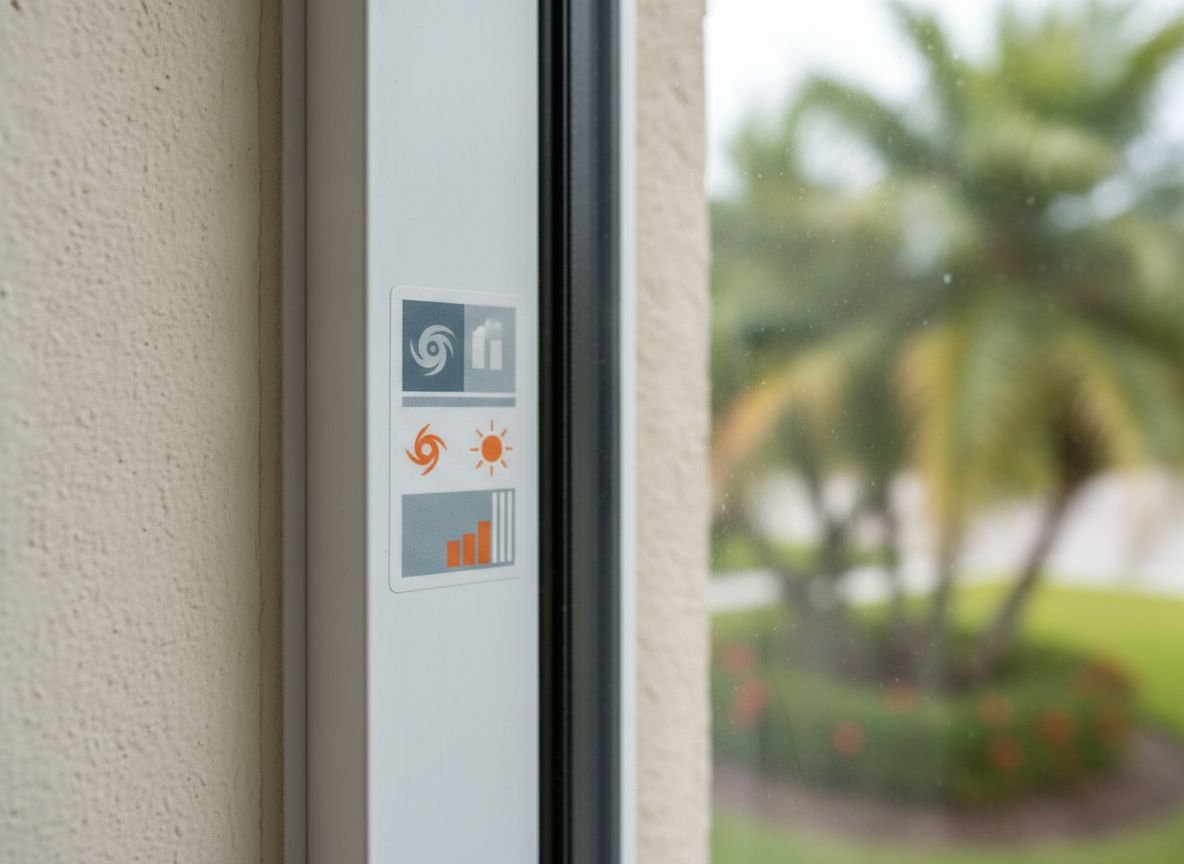
What actually makes a window "impact-rated"
An impact-rated window isn't just thicker glass. It's a system: laminated glass (two or more layers of glass bonded to an interlayer, usually a polyvinyl butyral or ionomer film) set into a frame that's been reinforced and anchored to hold that glass in the opening even after the outer layer cracks. The whole assembly — glass, frame, anchoring, and installation method — gets tested together, not the glass alone.
The tests that matter are ASTM E1886 (structural performance under cyclic wind pressure, simulating the repeated gusting of a hurricane) and ASTM E1996 (large and small missile impact — a 9-lb piece of lumber fired at roughly 34 mph for the large-missile test, plus steel ball impacts for small missile). A window that's genuinely impact-rated has been through both, not just one, and the test report ties to that specific product line, size range, and installation method — not a general marketing claim.
A standard window, by contrast, uses either annealed or tempered glass. Tempered glass is stronger than annealed against everyday impact, but when it fails it shatters into small pieces and comes out of the frame — it isn't designed to stay intact under repeated storm-force pressure cycles or hold against wind-borne debris. See our companion guide on laminated vs. tempered vs. insulated glass for the physical differences.
What the cost difference actually looks like
Impact windows cost more than standard windows — the laminated glass, reinforced frame, and heavier hardware all add material and manufacturing cost, and installation typically requires more precise anchoring to the opening. How much more depends heavily on frame material, glass package (single laminated pane vs. a laminated-plus-insulated-glass unit), size, and how many openings you're doing at once. We don't publish blanket price-per-window numbers here because the honest answer changes with your specific home — see our cost guide for the full breakdown of what drives price.
What's worth knowing going in: the gap between "impact" and "standard plus separate storm shutters" is often smaller than people assume once you account for the cost of shutter hardware, the fact that shutters need to be installed before every storm, and that they block light and views for however long they're up.
The honest answer: not every Orlando home is required to have it
This is the part a lot of sales conversations skip past. Florida's strictest window requirements — the High-Velocity Hurricane Zone (HVHZ) — apply only to Miami-Dade and Broward counties. Orange County, where most of the Orlando metro sits, is not in the HVHZ. Beyond that, the Wind-Borne Debris Region (WBDR), which does require impact protection (windows or shutters) on new construction and some renovation work, is generally tied to coastal proximity at 130+ mph design wind speeds, or anywhere at 140+ mph — and most inland Orange County addresses currently fall outside that region too.
That's changing at the margins: the incoming 9th edition of the Florida Building Code, effective December 31, 2026, may expand WBDR boundaries to cover some inland, lake-adjacent areas. Whether that affects your specific parcel is a real question with a real, address-specific answer — not something to guess at from a blog post. We cover the mechanics of HVHZ vs. WBDR vs. neither in detail on our hurricane protection page, and we're glad to look up your specific address rather than have you assume either way.
When impact windows are worth it even if not required
A lot of Orlando homeowners choose impact windows even when their address isn't code-required to have them, for reasons that have nothing to do with a permit checklist:
Insurance credits. Florida's wind mitigation inspection process (the OIR-B1-1802 form your insurer uses) can credit impact-rated openings, and some carriers weight this meaningfully in premium calculations. We can't promise a specific discount amount — that's between you and your carrier — but it's a real line item worth asking about.
No shutter routine. If a storm is approaching, impact windows mean you don't need to haul out panels, find your drill, and put up shutters under time pressure — the protection is already installed and permanent.
Noise reduction. Laminated glass is meaningfully better at attenuating outside noise than standard single-pane or even standard double-pane glass, because the interlayer damps sound transmission. This matters more than people expect if you're near a busy road or under a flight path.
Forced-entry resistance and UV blocking. The same lamination that resists wind-borne debris also resists someone trying to break in through a window, and most laminated interlayers block a large percentage of UV transmission, which helps protect flooring and furniture from fading.
How to decide for your home
Start with the address-specific question: are you in the WBDR, near its edge, or clearly outside it? Then weigh the non-code reasons — insurance, convenience, noise, resale — against the cost premium for your specific window count and sizes. There's no universal right answer; it depends on your coverage situation, how long you plan to stay in the home, and what your existing windows' condition is.
Request a Free Assessment