Tempered glass: strong, but designed to shatter safely
Tempered glass is regular glass that's been heat-treated (or in some processes, chemically treated) to put the surface under compression, which makes it roughly four times stronger than standard annealed glass against everyday impact and thermal stress. It's required by building code in specific "hazard locations" — shower enclosures, doors, and glass near floor level — because when tempered glass does fail, it's engineered to break into small, relatively dull granules instead of long dangerous shards.
That failure mode is exactly why tempered glass alone is not the basis for impact-rated windows: once it breaks, it comes apart and falls out of the frame. In a hurricane, a window needs to stay in the opening after the first impact to keep wind and rain out and to keep flying debris from entering the home on a second or third hit. Tempered glass doesn't do that on its own.
Laminated glass: the actual basis for impact ratings
Laminated glass is two or more layers of glass permanently bonded to a plastic interlayer (commonly polyvinyl butyral, PVB, or an ionomer interlayer in higher-performance products) under heat and pressure. When laminated glass is struck hard enough to crack, the interlayer holds the broken pieces together and keeps the assembly intact in the frame — the glass may craze and spiderweb, but it doesn't come apart or fall out.
This is the property that impact-rated windows are built around. The ASTM E1996 test standard for impact-rated products (large-missile impact plus thousands of pressure cycles simulating sustained hurricane winds) is testing whether the laminated glass and frame system stays in the opening after being struck — not whether the glass avoids cracking at all. A laminated impact window is expected to show some surface damage after a real debris strike; the point is that it keeps doing its job as a barrier even after that damage.
Insulated glass units (IGU): the energy-efficiency layer
An insulated glass unit, sometimes called double-pane or double-glazed glass, is two (or occasionally three) panes of glass separated by a sealed air gap, usually filled with a low-conductivity gas like argon, with a spacer bar around the perimeter maintaining the gap. The point of an IGU isn't impact resistance — it's thermal performance. The trapped gas layer slows heat transfer through the window far more effectively than a single pane of glass alone, which directly affects your home's cooling load and comfort, especially on sun-exposed walls.
Many IGUs also include a low-emissivity (Low-E) coating — a microscopically thin metallic layer on one of the interior glass surfaces that reflects infrared heat while still allowing visible light through. In Florida, Low-E coatings tuned for hot climates are typically chosen to reject solar heat gain rather than retain interior heat, which is the opposite priority from a cold-climate Low-E coating.
How they combine in a real impact window
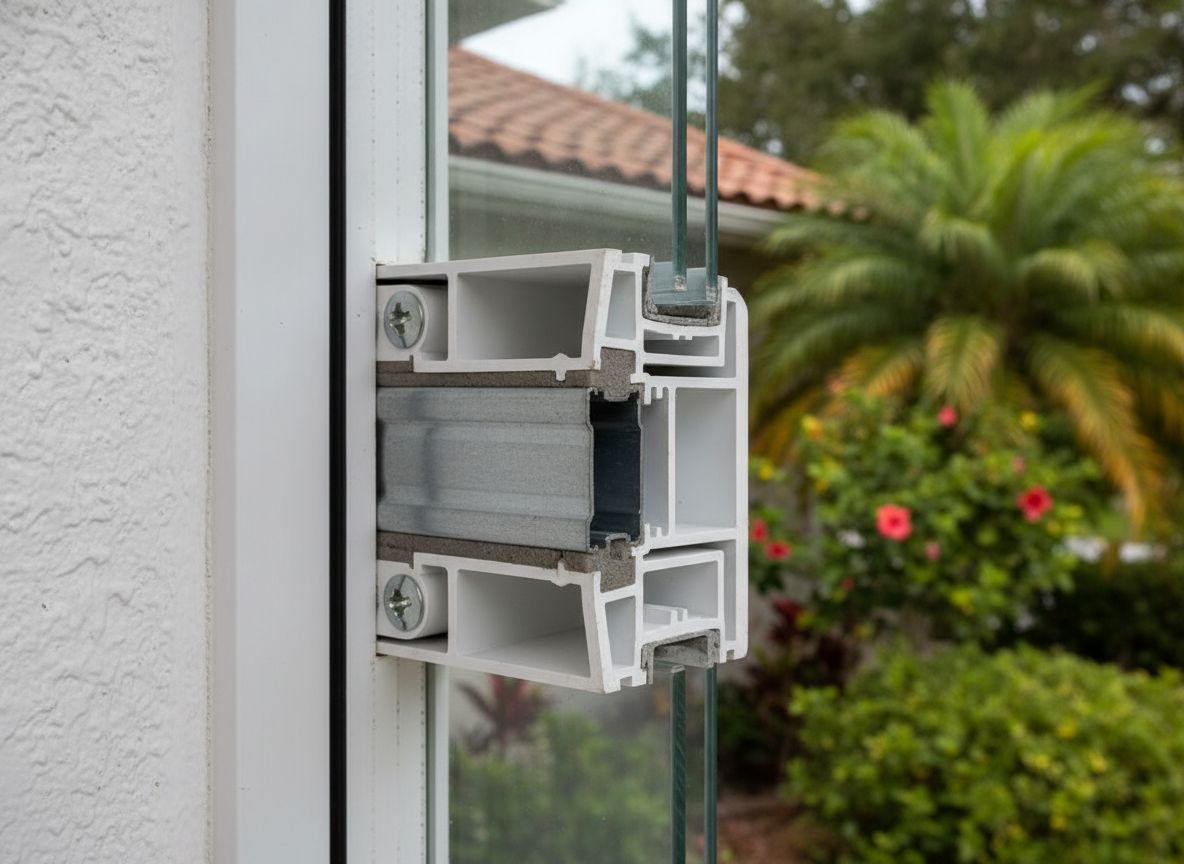
A modern impact-rated window sold in Florida is very often a laminated-glass insulated unit: one or both panes of the IGU are laminated (with at least the exterior-facing or a structural pane being laminated to meet impact testing), and the sealed insulating air gap is retained for energy performance. This gives you impact resistance and reasonable thermal performance in the same assembly, rather than having to choose one or the other.
Not every impact window is built this way — some lower-cost impact products use a single laminated pane without an insulating air gap, which meets impact testing but gives up some energy efficiency. When comparing products, ask specifically whether the glass package is a laminated IGU or a single laminated pane, and check the NFRC label for U-factor and Solar Heat Gain Coefficient (SHGC) — see our AAMA vs. NFRC ratings guide for how to read those numbers.
What this means when you're comparing quotes
If two quotes both say "impact-rated," ask what the actual glass makeup is — laminated single pane vs. laminated IGU — because that difference affects both your energy bills and, in some cases, noise reduction (thicker or asymmetric laminated/IGU combinations can meaningfully improve sound attenuation over a single laminated pane). It also affects price, so understanding what you're comparing helps you evaluate whether a cheaper quote is a better deal or a different, lower-spec product.
Request a Free Assessment