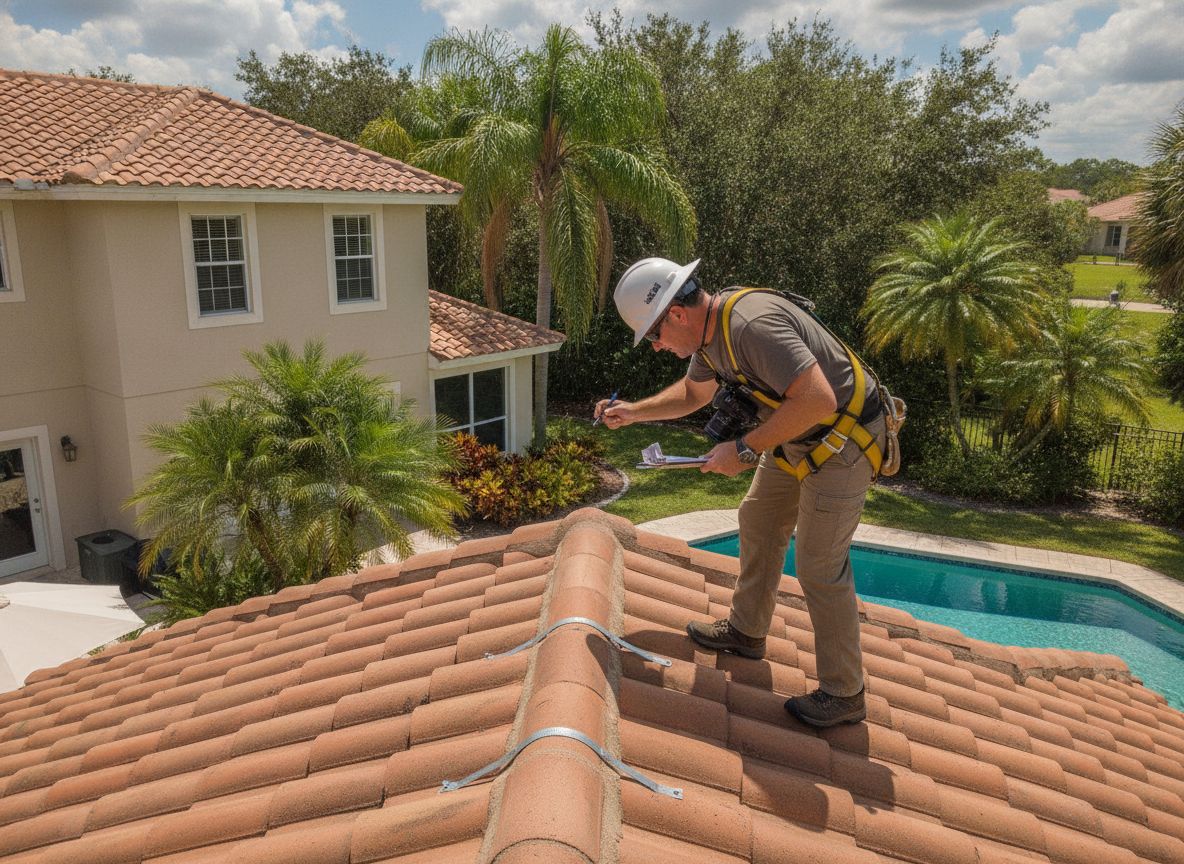
What a wind mitigation inspection is for
Under Florida law (Fla. Stat. §627.0629), insurers are required to offer premium credits, discounts, or other rate differentials to homeowners whose property has verified wind-resistant construction features. A wind mitigation inspection is how those features get verified. Without it, your insurer has no documented basis to apply a wind mitigation credit to your policy — even if your home genuinely has impact windows, a reinforced roof, or hurricane straps.
The inspection results are recorded on Florida's standard form, the OIR-B1-1802 Uniform Mitigation Verification Inspection Form. We cover that form specifically in our OIR-B1-1802 guide — this page focuses on the inspection itself: what gets checked and how.
What the inspector actually examines
A wind mitigation inspection walks through several categories of construction features, each of which can affect your credit:
Roof covering and roof shape. The inspector documents the roof covering type and installation date, and notes the roof's geometry — hip roofs generally perform better in high wind than gable roofs, and that geometry is recorded.
Roof deck attachment. How the roof deck (the plywood or OSB sheathing) is fastened to the roof trusses or rafters matters significantly — nail spacing and pattern make a measurable difference in wind performance, and stronger attachment methods (screws, adhesive, closer nail spacing) score better.
Roof-to-wall connections. This is often the single most consequential item on the form. Toe nails alone are the weakest connection; clips are better; single wraps and double wraps of hurricane straps provide progressively more capacity to keep the roof attached to the walls under uplift pressure.
Secondary water resistance (SWR). A self-adhering waterproof membrane or equivalent barrier applied under the roof covering, which limits water intrusion if the primary roof covering is damaged during a storm.
Opening protection. This is where impact windows, doors, and garage doors come in directly. The inspector documents whether every exterior opening — windows, entry doors, sliding glass doors, garage doors, and skylights — is protected by impact-rated glazing or code-rated shutters, and importantly, whether that protection is consistent across every opening. A home with impact windows everywhere except one vulnerable garage door does not get full opening-protection credit, because a single unprotected opening can compromise the whole building envelope in a storm.
Who is qualified to perform the inspection
Not just anyone can complete an OIR-B1-1802 form that an insurer will accept. Under Florida law (Fla. Stat. §627.711), the inspection must be performed by a qualified inspector — generally a licensed contractor, professional engineer or architect, or a certified home inspector meeting the statutory criteria, each acting within the scope of their license or certification. We can refer you to a qualified inspector to complete your wind mitigation inspection; we don't want to overstate our own ability to self-certify this form if that isn't squarely within our license scope.
What it typically costs
Cost varies by inspector, region, and home size, and we'd rather point you to a specific quote from a qualified inspector than publish a number here that might not reflect current Central Florida pricing. One cost-saving note worth knowing: Florida's My Safe Florida Home program offers free wind mitigation inspections to qualifying homeowners — see our My Safe Florida Home guide for eligibility details.
How the results feed into your insurance
Once the inspection is complete, the qualified inspector fills out and signs the OIR-B1-1802 form, documenting each category above. You then submit that form to your homeowners insurance carrier. The carrier applies whatever credits its filed rate plan specifies for the verified features — this varies by company, because each insurer files its own wind mitigation credit schedule with the Florida Office of Insurance Regulation. We can't promise a specific discount amount, because that determination belongs to your carrier, not to us or to the inspector. See our companion piece on whether impact windows actually lower your premium for more on that variability.
How long the inspection is valid
The current version of the OIR-B1-1802 form, revised effective April 1, 2026, is valid for five years from the inspection date, unless features change (for example, a roof replacement) that would require a new inspection sooner. That five-year window means a wind mitigation inspection isn't a one-time cost you pay every renewal — it's a longer-term investment in your policy's rate basis.
When to schedule one relative to a window and door project
If you're planning to install impact windows, doors, or a garage door, the most efficient sequence is usually to complete the installation first, then schedule (or re-schedule) the wind mitigation inspection so the inspector can document the new opening protection alongside your home's other features. Getting inspected before the work is done means you'd need a follow-up inspection afterward to capture the upgrade.
Request a Free Assessment