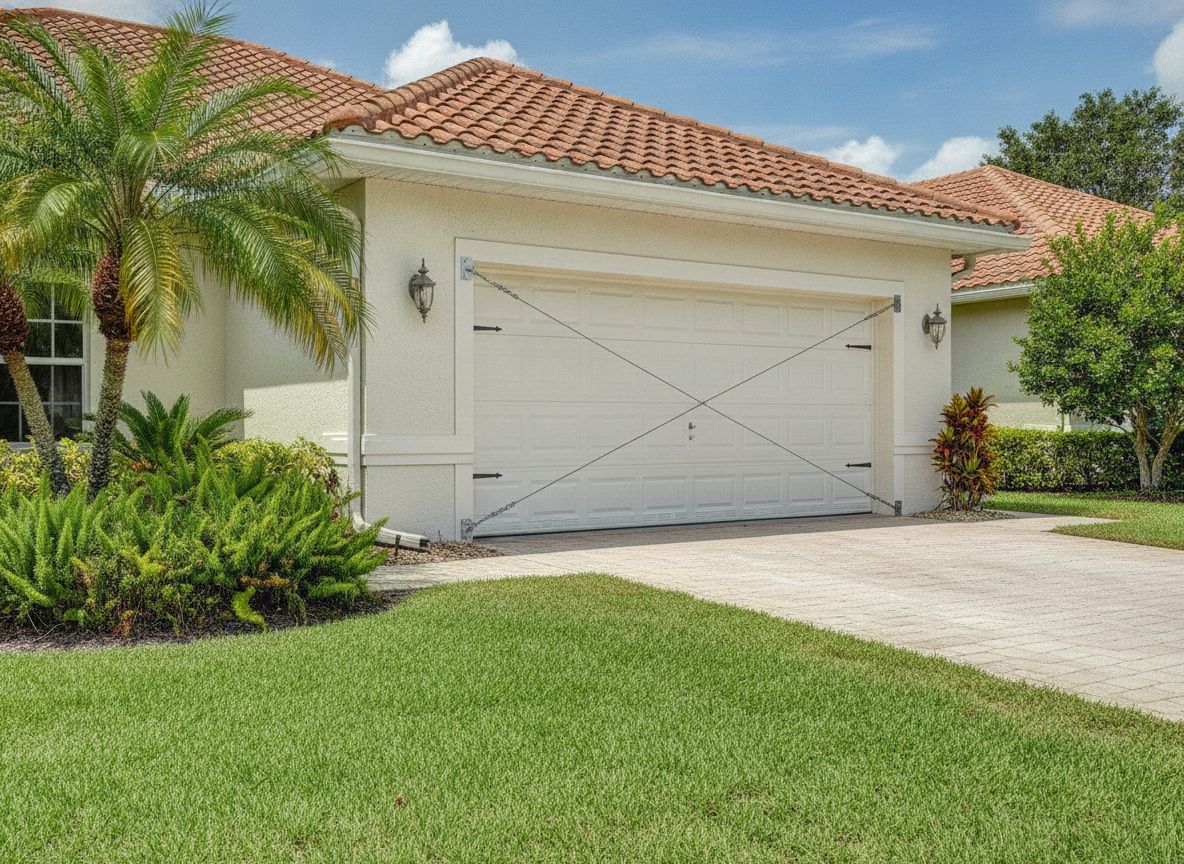
The largest unsupported opening on most homes
Walk around a typical single-family home and compare openings: windows are a few square feet each, an entry door is maybe 20 square feet, but a two-car garage door is commonly 16 feet wide and 7 feet tall — well over 100 square feet of surface area, all of it a single moving panel rather than a fixed wall section. That size alone makes it the largest concentrated wind load point on most house exteriors, and it's often built with less structural mass than the walls around it.
Standard, non-reinforced garage doors are typically thin steel or aluminum panels with lightweight internal bracing designed for daily lifting, not for resisting sustained hurricane-force wind pressure. Under load, an under-built door can bow, buckle at the track rollers, or blow inward or outward, especially older doors that predate more recent wind-load standards.
What happens when a garage door fails
The reason garage door failure gets so much attention from wind engineers isn't just the damage to the door itself — it's what happens to the rest of the house afterward. When a garage door blows in, wind that was previously being deflected around the building envelope suddenly has a large, direct path into the structure. That creates a positive internal pressure inside the home that pushes outward against the roof and walls from the inside — the opposite direction those structures are usually designed to resist.
This internal pressurization is a well-documented contributor to roof and wall failures during hurricanes: a home that might have otherwise weathered the storm with its envelope intact can suffer much more extensive structural damage once wind gets a large opening to push through. This is the core reason garage doors get specific attention in wind mitigation inspections and in newer Florida code requirements for garage door wind ratings in many jurisdictions.
Why older doors are especially vulnerable
Garage doors installed years ago, before more recent wind-load requirements were in place in many areas, are more likely to lack adequate bracing, robust track anchoring, or reinforced end hardware. Age also compounds the risk: tracks, rollers, and hinges can loosen or corrode over time, especially in Central Florida's humidity, reducing the door's ability to hold up even to its original rated pressure. If you don't know when your garage door was installed or what wind rating (if any) it carries, that's worth finding out before storm season, not during it.
Reinforcement kits vs. full replacement
There are two general paths to addressing a vulnerable garage door: aftermarket reinforcement (bracing kits that add horizontal struts and stronger anchor points to an existing door) or full replacement with a door engineered and tested as a wind-rated or impact-rated system from the factory.
Reinforcement kits can improve an existing door's wind resistance and are a lower-cost option, but they're only as good as the door and track system they're attached to — bracing a door that's already old, dented, or has worn rollers and hardware has real limits. A full replacement with a door specifically engineered and tested as a unit (panel, track, rollers, and hardware all rated together) gives you documented performance rather than an improvised upgrade, and is generally the more reliable long-term solution, particularly for doors that are already older or showing wear.
Why this is often the highest-value single upgrade
Compared to other hurricane-hardening projects, upgrading a vulnerable garage door is frequently one of the most cost-effective ways to reduce a home's overall storm risk, because it addresses the single largest opening with the least existing reinforcement. It's also a project most homeowners can complete in a single day of install time (see our guide on typical door replacement timelines), and it now carries an additional cost benefit thanks to Florida's new sales tax exemption on qualifying impact-resistant garage doors — see our article on the 2026 tax exemption for details.
Whether reinforcement or replacement is right for your specific door depends on its age, condition, and current rating. See our hurricane protection overview for how to think through a whole-home assessment.
Request a Free Assessment